Custom Search

Friday, March 12, 2010

Week of Riding for 03/06-03/13


FRIDAY ENTIRE WORKOUT


FRIDAY NORMALIZED POWER 60 MINUTES 259 WATTS


THURSDAY COFFEE CREW ENTIRE WORKOUT


WEDNESDAY RIDE


TUESDAY COFFEE CREW


Ending......Duration..Distance..Weight...HR......TSS.......kJ
3/14/2010..13:13:45..232.27....150.0....141......681.....7262               
3/7/2010..25:16:16 ...434.83....150.0....150......651.....7672         


Sunday, March 7, 2010

Spring Death Valley Double Century -- 2nd Place

Just a quick post.  I had a great day on the bike.  I came in second with another rider Ton Van Daelen.  I also PR'd the course by an hour 11 hours 8 minutes-- unofficially.  I am working on a race report now so stay tuned...

Friday, March 5, 2010

Spring Death Valley Double Century Course Details


Courtesy of AdventureCorps


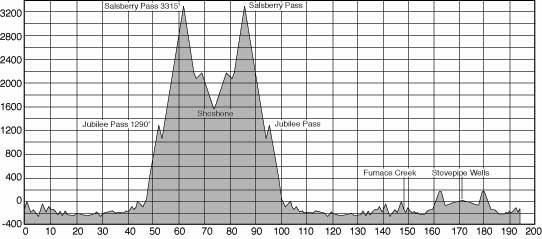
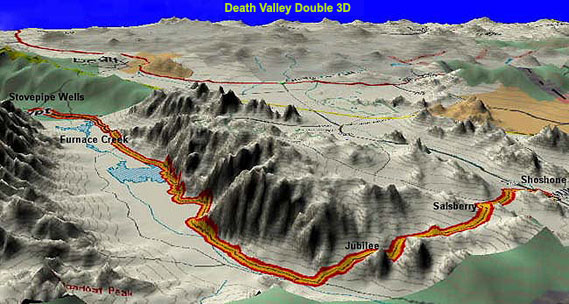
The two major climbs exiting Death Valley on the southern end


Stage Four: Furnace Creek to Shoshone, 73.6 miles. Elevation Gain: 6744'.
South through Death Valley, the alluvial fans are invisible in the dark, but you climb and descend several thousand feet through Badwater (El -282’) to the base of the exit passes (Mountain Section Six). The first climb starts at mile 300 and climbs about 1000 feet in five miles to Jubilee (El 1285’). A one-mile descent leads to the next climb, about 2300 feet in 9.5 miles to Salsberry (El 3315’). Each climb has sustained sections of 5-5% grade and usually poor road surface; in fact, all of the road is terrible after you pass Badwater.


I am using the course description from the 508 website because the Spring Death Valley Double Century or Southern Route is mainly on the 508 route.  On the double when we reach Shoshone we turn around and head back to Furnace Creek.  


Hydration

Death Valley got it's name because it is a place were living things go, get dehydrated, and die. Death Valley has the driest climate on this planet. Most of the time there is practically no moisture in the air at all. This means every breath goes in dry and comes out wet. When you are sleeping in Death Valley your body processes about a pint of water an hour by breathing. This means at the end of 8 hours sleep you have consumed about 1 gallon of water. You must hydrate and replace your electrolytes even when you are not cycling. Therefore we suggest you bring a Camelbak!


Double Century Checkpoint Locations: 17.7mi (Badwater), 45.4mi (Ashford Mill), 57.6mi (Water Only - on Salsberry Pass), 74.3 (Shoshone), 103.2 (Ashford Mill), 130.9 (Badwater), 148.6 (Furnace Creek), and 171.5 (Stove Pipe Wells).


A question came up about how much fluids I will consume on the double century.  This is a supported double but even though I have the luxury of support I usually will skip three of the aid stations.  


Mile 0-------2 full bottles with Infinit Nutrition from the start at Furnace Creek
Mile 17.7---Pass on Badwater 
Mile 45.5---2 full bottles at Ashford Mills
Mile 57.6---pass on water stop
Mile 74.3---2 full bottles in Shoshone
Mile 103.2--2 full bottles in Asford Mills
Mile 130.9--2 full bottles at Badwater
Mile 148.6--pass Furnace Creek 
Mile 171.5--2 full bottles Stove Pipe Wells 
Mile 196--- A big ass Coke!


So it looks like 12 24oz bottles.  That's the plan anyway.  But I've done this event a few times and many times I arrive at the aid station and still have fluids left from the last station.  


BUT the big news is the weather 50% chance of rain and snow is forecasted for Death Valley on Saturday.  For people that live outside of southern California and around the world many of you can't understand why rain is such a big deal for us.  You have to understand that we have a very moderate climate year round.  We also don't go out and buy all the rain gear needed to ride in the rain i.e. fenders, clothing, and such.  We can always wait a day and the rain will pass. Typically it doesn't rain one drop from April -- November.  So for us rain is a BIG deal.  


Weather forecasts are provided below.
See here


here


and and the wildflower update can be found here

Thursday, March 4, 2010

Velo 6-0-5 group ride

I got a late start and I was almost sure I would miss the 6am Wednesday Ride at UCI.  I left my house at 4:57am when I really should leave at 4:50am if I want to make the ride.  It's twenty miles from my house to the ride start with a 1.5 mile climb that I usually avg about 10 mph that early in the morning.  So I decided to join up with the Velo 6-0-5 group that meets at Peet's Coffee on PCH and Avocado at 6:05am ;)  I didn't know what their workout was going to be since I had never ridden with them but it was just what I was looking for-- mid week hill work.

We did Newport Coast Dr. (1.5 miles 450 feet of gain) with different variations and included Vista Ridge a couple of times.  I've been wondering how I would get significant climbing in with my new work schedule.  For the time being I will have to use the local terrain and just suffer at the events.  I am training for the Mount Laguna Bicycle Classic (MLBC) in April and the Breathless Agony in May.  Mount Laguna has 10,000 feet of climbing in 100 miles, and Breathless Agony has 12,000 in 114 miles, 11,000 feet of which come in the first 72 miles.  You can read my MLBC pre-ride report here.

Having seen the stats above I think now you can appreciate more clearly my dilemma -- how can I train for 10,000 ft climbing days on a 450 feet climb? Or how can I train on a 1.5 mile hill when the requirements of the race are 10 mile climbs or Breathless with it's massive 30 miles of almost continuous climbing from Mill Creek to Onyx Summit at 8443 feet summit? Just look at the map provided below it's flat terrain all around me.   As I've said in previous posts --- this will be an interesting season.


Ok on to the geek stuff here is my workout.


Garmin download elevation and power


All Repeats


Repeat #1 Steady used as a warm-up


Vista Ridge- a steep 10% average


Vista Ridge power displayed as w/kg


Newport Coast Repeat #2 


Newport Coast Repeat #2 w/kg


Newport Coast Repeat #3-- Seated


Newport Coast Repeat #4 -- Standing


And then I lost motivation and did an easy #5 repeat.  I just couldn't get into the 5th repeat or go up to Vista Ridge again.  But I will as the season continues.  


Tuesday, March 2, 2010

Spring Death Valley Double Century

Thank you for stopping by and reading my blog.  I appreciate your support.

What's next for the Red Eyed Vireo?  The spring edition of the Death Valley Double Century.  The event will be held on March 6th in Death Valley.  The Death Valley Doubles and the Furnace Creek 508 are some of my favorite events all year.  The beauty of Death Valley National Park is just something to behold for yourself.

My goal for the event is to finish in under 12 hours.  I have yet to finish any of the Death Valley doubles in less than 12 hours.  I have come close before with a 12:11 time back in 2006 report here.  In 2006, I was really fit after having done Everest Challenge, Furnace Creek 508 just prior to the Death Valley Double.   In five weeks I did over 900 racing miles and 75,000 
feet of climbing and I felt great.  My only mistake that day was I sat on the 
day was drafting the wrong wheel for too long and
 letting the lead riders go away.  


I am very curious to see what my form is like since I really haven't done long training rides.  My training this year has consisted of 
short medium to high intensity group rides.  My new work schedule prevents me from doing the 100+ mile training rides 
that I have usually done to get ready for double centuries.  


Saturday, February 27, 2010

Power Q & A

Some questions have arisen because of my recent power charts.  So I thought I would cover a few basics.


What are kjs/

video here


  1. A unit or measure used to express the total training load.
  2. The average power output in watts multiplied by the time in seconds divided by 1000.

Most people use the kjs to see how much work they have done on a ride or an interval.  It is also used as an energy expenditure measurement because it is closely related to calories expended.  On my Ultras I average between 550-600 kjs an hour.  The harder you ride the more watts you put out which then translates to more kjs.  Someone that weighs more will put out more wattage consistently throughout their ride and consequently will have more kjs by the end of their ride/race.  

Conversely, the shorter the distance the harder you can ride and accumulate more kjs.  So while I may put out 700-750 kj in an hour during a club ride I will be in the 550-600 kj range on Ultras.  After my long races my kjs are over 10,000 kjs and as much as 15,000 kjs.  Refer to my website for a comparison of three Ultras I completed in 2009 question 15.  Just think how much food I needed to eat to replenish all those calories ;)  Ever wonder why I do Ultras -- because I love to eat!

If I average 300 watts on a climb of 30 minutes I will expend 540 kjs.  Here is the math.

300 x 1800 seconds (30 mins x 60 secs) = 54000

54000 / 1000 = 540 kjs

But don't worry you don't have to do the math the power meter does all that for you .  

By the way, 300 watts would be 4.42 w/kg which for me is a hard effort. 

TSS- Training Stress Score

Training Stress Score takes into account both the intensity (i.e., IF) and the duration of each training session.  The duration of an exercise is easy to figure out -- just look at your watch.  But the IF or Intensity Factor needs a little more explaining.  The IF is how hard you are working in relation to your Threshold Power.  So if you are working at 75% of your threshold, Training Peaks shows it as .75.  And 75% of of 275 watts would be  206 watts.  The TSS calculates how long you are working and at what percentage of your threshold and gives that workout a score.  


The very first thing a cyclist working with a power meter should do is perform a field test. A specific protocol can be found on the the Training Peaks website.  The field test will help you discover your threshold power number as will as the rest of your power training zones.  

And how do you find your Threshold Power?  Let's first describe Lactate Threshold.   Lactate threshold (LT) - is a predictor of an athlete's endurance performance ability.  Maximal oxygen uptake (VO2 max) is an indicator of the an individual's cardiovascular fitness.   VO2 max sets the upper limit to their rate of aerobic energy production but their metabolic fitness, i.e., their LT, determines the percentage or fraction of their VO2max that can they can utilize for any given period of time.  In other words, we can find where an athlete's redline is with their VO2 max but their LT tells how close to that redline someone can train or race and stay in an aerobic zone.

Variability Index (VI)

1.  Is a measure of steady vs erratic pacing.  


2. Compares Normalized Power and Average
Power (VI=NP/AP)

3.  VI = 1.0 means perfect pacing for a steadystate
session (TT, triathlon)

4.  VI > 1.0 indicates a decrease in steady pacing.


So the closer to 1.0 the more steady an effort was.  Road races have constant attacks and pace changes so the VI can be as much as 1.30.

Pw HR:

Is a way of illustrating how much of a change there is from the first half of the interval/workout and the second half.  Steady state intervals would have very little if any separation.  It can also illustrate an athletes aerobic fitness.  You may see how in the first half of a Time Trial an athlete goes out too hard because his second half would have the same power output or slightly less but his heart rate would be drifting upward.  

In the posting the 13% decoupling is quite high but it wasn't a steady effort.  The goal would be 5%.  

Videos from Joel Friel


Friday, February 26, 2010

New 5 min Normalized Power- 340W


Today's Friday ride was a good one.  I felt good throughout and tried to ride "off the front" or just ahead of the pack so as not to draft.


 Entire workout (155 watts):
Duration:   2:40:48 (2:50:44)
Work:       1497 kJ
TSS:       163.7 (intensity factor 0.784)
Norm Power: 216
VI:         1.39
Pw:HR:       -2.29%
Pa:HR:       -0.98%
Distance:   50.806 mi
                Min....Max...Avg
Power:       0......792....155 watts
Heart Rate:   26....190...145.bpm
Cadence:     30... 218...85 rpm
Speed:       2.2.. 40.7..19.3 mph
Pace         1:28..26:49...3:06 min/mi
Crank Torque: 0....903... 155 lb-in


Peak 5min (267 watts):
Duration:   5:00
Work:       80 kJ
TSS:       12.7 (intensity factor 1.235)
Norm Power: 340
VI:         1.27
Pw:HR:       -39.49%
Pa:HR:       20.8%
Distance:   1.808 mi
                  Min...Max...Avg
Power:       0..... 668...267 watts
Heart Rate:   164...190...180 bpm
Cadence:     77...123...94 rpm
Speed:       15.7..26.5...21.7 mph
Pace         2:16 3:50 2:46 min/mi
Crank Torque: 0...679...245 lb-in


Today's weight 149.5lbs or 67.81 kg

340w/ 67.81kg = 5.01 w/kg for 5 minutes

Wednesday, February 24, 2010

Wednesday Ride plus Warner Loop


SCREEN SHOT FROM TRAINING PEAKS WKO 3.0

90 miles 


Entire workout (167 watts):
Duration:   4:50:24 (5:01:55)
Work:       2913 kJ
TSS:       276.3 (intensity factor 0.757)
Norm Power: 208 (3 w/kg)
VI:         1.25
Pw:HR:       11.24%
Pa:HR:       -11.54%
Distance:   89.51 mi

Min.. Max.. Avg
Power:       0... 946... 167 watts
Heart Rate:   7... 179... 147 bpm
Cadence:     30.. 212... 84 rpm
Speed:       2.2. 44.4.. 18.8 mph
Pace         1:21. 26:49.. 3:12 min/mi
Crank Torque: 0.. 1257... 171 lb-in


Today's weight 149lb 


I was late leaving my house. I arrived at the ride start a few minutes after they had rolled.   So  me and another rider, Matt, chased to catch the group.  I had to chase almost 27 miles.  Basically, I chased from my home in Huntington Beach to the start,19 miles, and then another 8 miles into their ride.  In the graph above you see my best 60 mins of the day and yes it turned out to be all the chasing I had to do JUST to get to the ride. 


DETAIL OF BEST 60 MINUTES


Peak 60min (199 watts):
Duration:   1:00:00
Work:       715 kJ
TSS:       71 (intensity factor 0.842)
Norm Power: 232  (3.43 w/kg)
VI:         1.17
Pw:HR:       -13.49%
Pa:HR:       1.36%
Distance:   17.572 mi
                  Min .Max...Avg
Power:       0......640..199 watts
Heart Rate:   99....177...157 bpm
Cadence:     30....196..81 rpm
Speed:       2.2.. 37.4..17.7mph
Pace         1:36..26:49..3:24min/mi
Crank Torque: 0......889...211 lb-in


Because I'm an Ultra cyclist I find it interesting that many of my best 60 minutes of power are without the group on the group rides.  It just goes to show there is a lot of drafting going on in the pack and that I need to be careful not to get spoiled since I can't draft in many of my Ultra races.  I would like to just sit out front and ride tempo the whole ride and see what type of numbers I come home with as a comparison.  

Coffee Crew Tuesday 022310

SCREEN SHOT FROM TRAINING PEAKS WKO 3.0

Interesting how my first hour getting to the group ride was my best 60 mins of the ride.

Tuesday, February 23, 2010

New 1 min Peak Power


SCREEN SHOT FROM TRAINING PEAKS WKO 3.0

My "new" 1 minute peak power number.  It is the same as the one I had back in August.  I'm calling it new because I lost all my data.  I now have a file to reference to if I want to look it up.

Today's weight 148lbs

534 watts /  67.13 kg = 7.95 w/kg

Which puts me at mid Cat 3 on the power profile chart above.